Health and Safety Policy for Commercial Waste Ilford and Surrounding Service Areas
 Purpose: This document sets out the health and safety policy that governs safe operations for our commercial waste Ilford activities and related rubbish collection services across our service area. The aim is to protect employees, contractors, clients, visitors and the public by describing responsibilities, controls, and safe working practices for commercial refuse removal and waste management. The policy applies to all waste streams handled by the business, including general commercial refuse, recyclable materials, and controlled or hazardous wastes where applicable.
Policy statement: We commit to maintaining a safe workplace and to continuously reducing risks associated with rubbish removal, transport and disposal. All team members must follow safe systems of work, use appropriate personal protective equipment (PPE), and participate in required training. Management will provide appropriate resources so that Ilford commercial waste services are delivered without compromising health and safety.
 Scope: This policy covers operational staff, drivers, loaders, site contractors and supervisory personnel involved in commercial waste collection, transfer, storage and disposal. It includes site-based activities such as bin handling, compacting, vehicle loading, street-side rubbish pickups and yard operations. The policy also addresses vehicle safety, lone working, manual handling and the segregation and safe transport of potentially hazardous items.
Responsibilities and Leadership
Management responsibilities: Senior management is responsible for establishing and maintaining the health and safety management system for commercial rubbish Ilford operations. Management will ensure risk assessments are completed, compliance is monitored, and that staff are competent for their roles. Regular reviews and audits will be carried out to ensure continuous improvement.
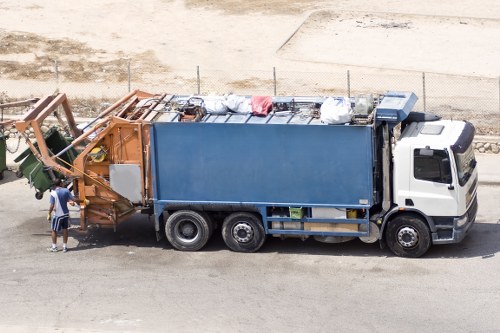 Employee responsibilities: Employees must follow all safe work procedures, report hazards or incidents promptly, and wear issued PPE. Staff must not remove safeguards or operate equipment unless trained and authorised. Everyone has a duty to cooperate with management to maintain a safe environment for our commercial waste removal and related services.
Contractors and subcontractors: All contracted personnel working on our behalf must demonstrate suitable competence, follow this policy and provide evidence of their own safety arrangements. Where subcontractors perform rubbish collection, transfer or disposal tasks, they must be made aware of site-specific arrangements and emergency procedures.
Risk Control, Training and Safe Systems
Risk assessments: Formal risk assessments are completed for routine tasks and for non-routine activities such as maintenance, spill response and handling suspect hazardous materials. Controls include safe lifting techniques, mechanised handling where possible, exclusion zones during loading, and clear traffic management to segregate pedestrians from vehicles involved in commercial waste collection.
 Training and competence: All staff receive induction training and periodic refresher training covering manual handling, vehicle operations, hazardous materials awareness, fire safety and emergency response. Records of training and competence assessments are retained as part of our health and safety documentation for commercial rubbish services across the service area.
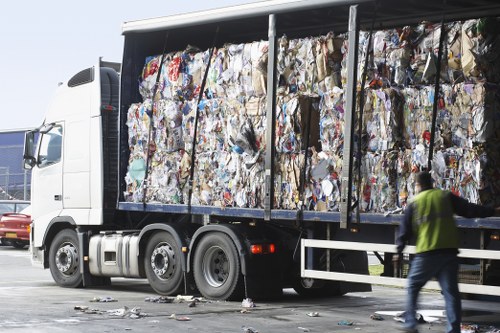 Personal Protective Equipment: Appropriate PPE — such as high-visibility clothing, gloves, protective footwear and eye protection — will be provided and maintained. Supervisors must ensure correct PPE is used for specific tasks and that faulty equipment is removed from service immediately. The use of PPE is a last layer of protection and complements engineering and administrative controls.
Vehicle and plant safety: Vehicles and mobile plant used for waste collection and transport will be operated only by trained employees. Pre-shift vehicle checks, secure loading practices and documented maintenance schedules reduce mechanical failures and incidents. Drivers must adhere to safe driving practices and any local traffic rules while delivering commercial waste collection services in and around the area of operation.
Hazardous and controlled waste: When dealing with potentially hazardous materials, the business will use authorised carriers and disposal routes. Segregation, labelling and secure containment are required to prevent contamination or exposure. In cases of unidentified or mixed suspect waste, work will stop and competent advice sought before recommencing operations.
Incident reporting and emergency response: All incidents, near misses and property damage must be reported promptly and investigated to identify root causes and corrective actions. Emergency plans are in place to deal with spills, fires, vehicle accidents and other incidents. Drills will be conducted regularly to ensure preparedness.
Monitoring and continual improvement: Performance is monitored via inspections, audits and analysis of incident trends. Corrective actions and documented improvements are implemented and reviewed. The policy will be reviewed at least annually or following a significant incident to ensure it remains suitable for our commercial waste operations.
Records and documentation: We maintain records of risk assessments, training, vehicle maintenance, incident investigations and waste transfer documentation. These records underpin safe management of rubbish removal and demonstrate our commitment to statutory compliance and best practice.
Commitment: This policy is endorsed by senior management and forms the basis for safe, reliable and responsible commercial waste removal. By following these principles, the organisation ensures that its rubbish collection and waste management services continue to operate safely and sustainably across the service area.
